ASLI INSIGHTS: Asia Unpacked | 2 March 2026
From Iran’s Supreme Leader, the war between Pakistan and Afghanistan, Malaysia’s unity index, the appointment of leaders in North Korea and The Netherlands to the use of Anthropic’s AI
Top news in Asia this week:
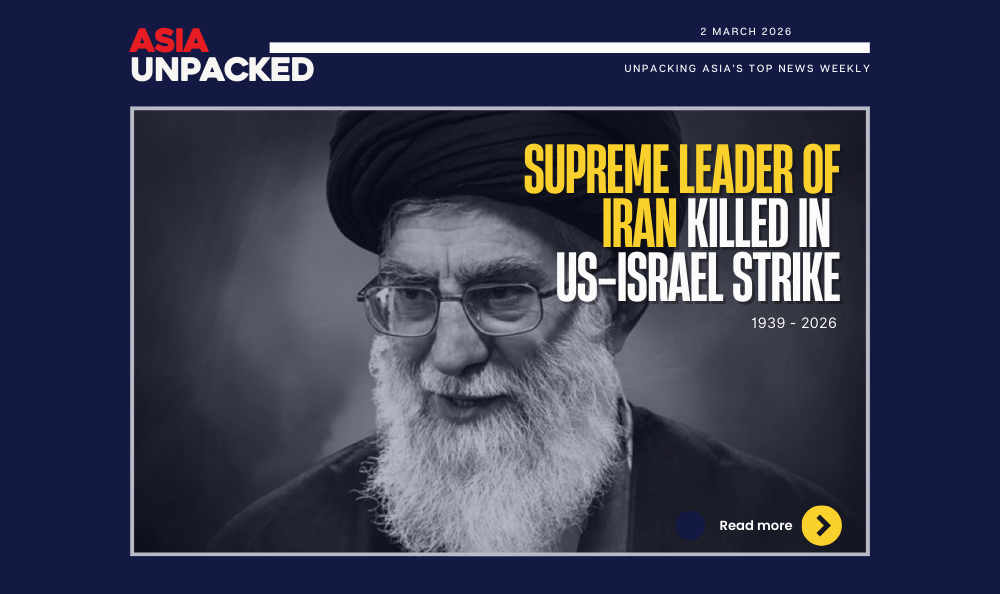
1. Supreme Leader of Iran killed in US-Israel strike.
Iran's Supreme Leader, Ayatollah Ali Khamenei, was killed on 28 February 2026, in a joint US-Israeli airstrike that targeted his high-security compound in Tehran. US President Donald Trump announced the assassination, which was subsequently confirmed by Iranian state media early Sunday, March 1. The strike also reportedly killed several of Khamenei's family members and senior Iranian military and security officials. In response, Iran launched retaliatory missile and drone attacks against Israel and US bases across the Middle East, while declaring a 40-day mourning period.
Read more:
2. Pakistan declares ‘open war’ with Afghanistan
Pakistan has bombed major Afghan cities, including Kabul and Kandahar, prompting its defense minister to declare an "open war" against Afghanistan.
The dramatic escalation follows a series of retaliatory cross-border attacks between the two nations, resulting in dozens of military and civilian casualties. Islamabad accuses the Taliban government of harboring militant groups like the Pakistani Taliban (TTP) and aligning with India. Kabul vehemently denies these allegations. Despite previous ceasefire attempts, tensions remain critically high as both sides continue to report significant losses and exchange heavy fire.
Read more:
3. Malaysia’s National Unity index rises
Malaysia’s National Unity Index reached 0.701 in 2025, exceeding government targets and continuing a steady upward trajectory since 2018.
This improvement was largely driven by positive public perceptions of governance and development.
Regionally, Sarawak achieved the highest score, whilst Pahang led the state-level rankings. National Unity Minister Aaron Ago Dagang noted that while these results reflect successful government efforts, national cohesion remains a fragile, ongoing process. Consequently, these findings will be utilised to refine future policies and ensure sustained progress in strengthening social unity.
Read more:
https://thesun.my/news/malaysia-news/malaysias-national-unity-index-rises-to-0-701-in-2025/
4. Kim Jong Un re-elected as party chief, Dutch elect youngest prime minister
In North Korea, the Workers' Party re-elected Kim Jong Un as general secretary during its Ninth Congress. Kim used the summit to emphasise his commitment to radically expanding the nation's nuclear arsenal and boosting the struggling economy despite international sanctions.
Meanwhile, in the Netherlands, 38-year-old Rob Jetten was sworn in as the country’s youngest prime minister. Following a narrow election victory over the far-right, Jetten now leads a centre-right minority coalition tasked with negotiating challenging legislative reforms on defence, healthcare, and sensitive asylum policies.
Read more:
North Korea:
https://www.bbc.com/news/articles/cvg18588mdko
The Netherlands:
https://www.bbc.com/news/articles/clygj3421pqo
5. Trump halts US agencies’ use of Anthropic AI over ethics debate.
US President Donald Trump has ordered all federal agencies to cease using Anthropic’s AI technology following a dispute over military applications. The clash began when Anthropic refused to grant the defence department unrestricted access to its tools, citing ethical concerns regarding mass domestic surveillance and fully autonomous weapons. In response, the administration labelled the firm a "supply chain risk", a designation Anthropic plans to challenge in court. Meanwhile, rival OpenAI secured a government contract while publicly supporting Anthropic's ethical boundaries against unregulated military use.
Read more:
https://www.theguardian.com/us-news/2026/feb/27/trump-anthropic-ai-federal-agencies