ASLI INSIGHTS: Asia Unpacked | 23 February 2026
From Trump’s tariff to UK, France, Germany’s decision on the Board of Peace, Venezuela’s law passage, Peru’s new interim president and Nvidia’s investment
Top news in Asia this week:
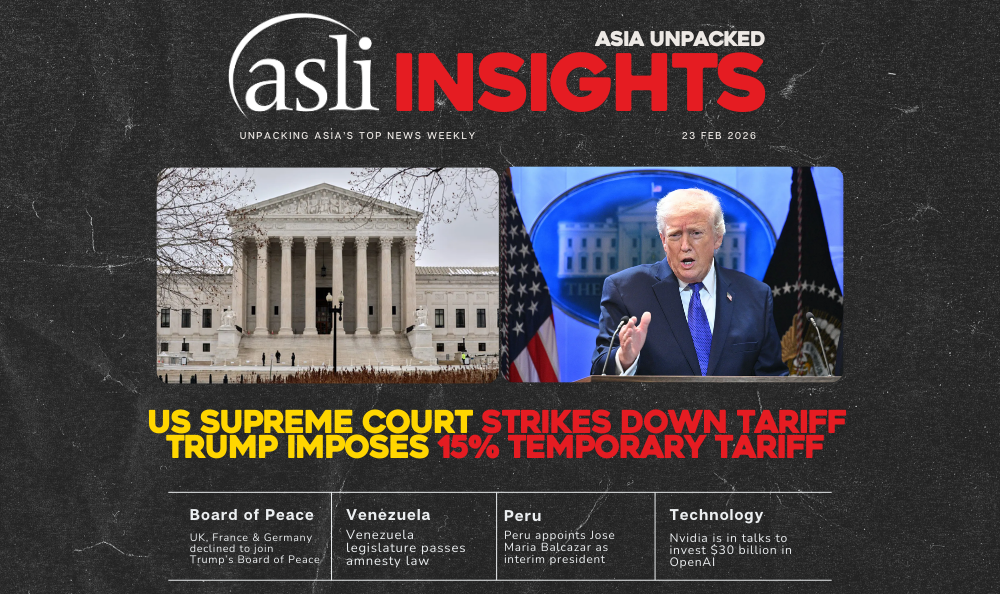
1.US Supreme Court strikes down tariff; Trump imposed temporary tariff at 15%
The US Supreme Court struck down President Trump’s global tariffs imposed under emergency powers, dealing a significant blow to his economic agenda. In a swift countermove, a defiant Trump criticised the justices and immediately announced a new, temporary 15% tariff on all imports using the Trade Act of 1974. While the administration frames this as necessary to protect US interests, global leaders and business groups have expressed alarm, warning that these escalating trade barriers and continued legal uncertainty could severely damage the global economy.
Read more:
Tariff Strikedown:
https://www.bbc.com/news/live/c0l9r67drg7t
Temporary Tariff:
https://www.theguardian.com/us-news/2026/feb/21/trump-tariffs-15-percent
2. UK, France & Germany declined to join Trump’s Board of Peace
Dozens of world leaders are meeting in Washington for the inaugural summit of Donald Trump’s controversial "Board of Peace", an initiative aimed at funding Gaza’s reconstruction and addressing global conflicts. However, the event faces significant scepticism as key US allies, including the UK, France, and Germany, declined invitations, citing concerns over the organisation's funding transparency and political mandate. With major European powers absent and the Vatican also opting out, critics question the board's legitimacy and ability to resolve the stalling Israel-Gaza crisis.
Read more:
https://time.com/7379643/trump-board-peace-countries-joining-rejected-invitations-membership/
https://www.theguardian.com/us-news/2026/feb/18/trump-board-of-peace-first-meeting
3. Venezuela legislature passes amnesty law
Venezuelan lawmakers have passed an amnesty law for political prisoners prosecuted during 27 years of authoritarian rule, a measure introduced by Acting President Delcy Rodríguez following US pressure. While the government frames this as a crucial step towards national reconciliation, rights groups and opposition leaders remain cautiously optimistic, demanding genuine freedom without conditions. Critics cite the recent re-arrest of a dissident as evidence of potential loopholes, even as the administration pledges to close the notorious El Helicoide detention centre.
Read more:
https://edition.cnn.com/2026/02/19/americas/venezuela-political-prisoners-amnesty-law-latam-intl
4. Peru appoints Jose Maria Balcazar as interim president
Peru’s Congress has appointed former judge and left-wing lawmaker Jose Maria Balcazar as interim president, replacing right-wing leader Jose Jeri, who was ousted amid corruption allegations dubbed "Chifagate". Balcazar’s appointment marks Peru's ninth presidency in a decade, highlighting ongoing political instability. His term will be brief, concluding after the general elections scheduled for April 12, 2026. Despite facing his own controversies, including past judicial misconduct, Balcazar secured enough congressional votes to lead the transition until a new president is inaugurated in July.
Read more:
https://www.bbc.com/news/articles/cvgkp84mmmvo
https://www.aljazeera.com/news/2026/2/19/peru-appoints-new-president-after-jose-jeris-removal
5. Nvidia is in talks to invest $30 billion in OpenAI
Nvidia is reportedly in talks to invest $30 billion in OpenAI, potentially valuing the AI startup at $730 billion. This investment is distinct from the previously announced $100 billion infrastructure partnership between the two companies. While details remain fluid and the deal is not yet final, reports indicate that this funding could be part of a larger round involving other major tech players like Amazon and Microsoft. The move comes amidst earlier speculation about the status of their partnership, which both CEOs have since downplayed.
Read more: