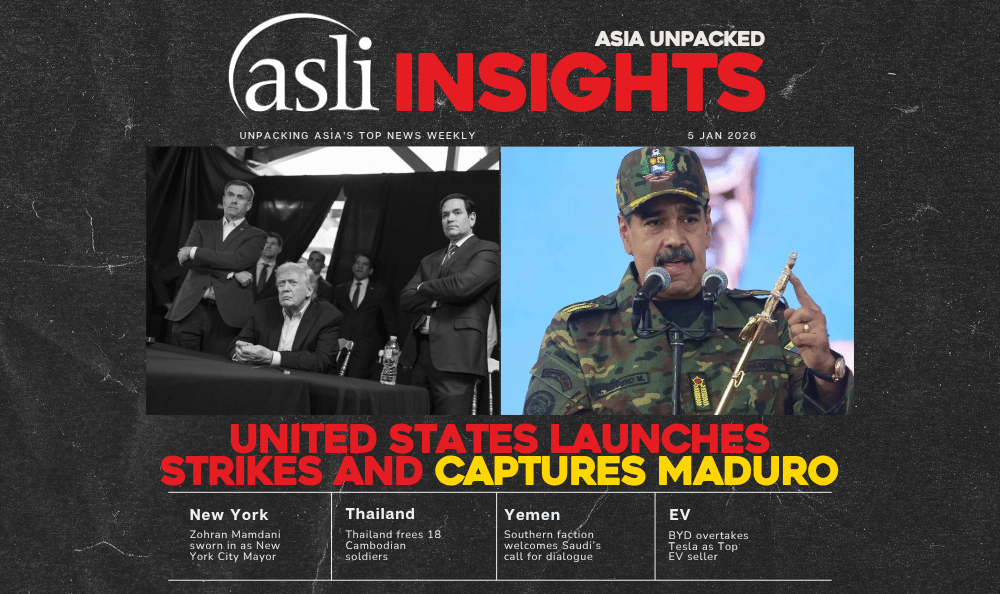
ASLI INSIGHTS: Asia Unpacked | 4 January 2026
From Nicolás Maduro’s capture, Zohran Mamdani’s inauguration as mayor, Thailand’s act of diplomacy, Saudi Arabia’s call for dialogue and BYD’s advancement as a top EV seller, this week highlights boldness, dialogue and a new beginning.
Here’s what’s making headlines:
1. United States launches strikes and captures Maduro
In a swift military operation involving over 150 aircraft, U.S. forces captured Venezuelan President Nicolás Maduro and his wife, Cilia Flores, transporting them to New York to face narco-terrorism charges. President Trump announced that the U.S. will temporarily "run" Venezuela and its oil industry, claiming Vice President Delcy Rodríguez had been sworn in as a transitional leader. However, Rodríguez disputed this in a televised address, labeling the capture an "atrocity" and demanding Maduro’s release. While the Trump administration argues the strike was a legal exercise of executive authority against a criminal enterprise, some U.S. lawmakers have condemned it as an unauthorized act of international dominance. The region remains in a state of high uncertainty as the impact on Venezuela's military and civil order unfolds.
Read more:
https://apnews.com/article/venezuela-us-maduro-what-to-know-a57528ff315a7f70ed51a1721f5e0bc2
https://www.bbc.com/news/live/c5yqygxe41pt
2. Zohran Mamdani sworn in as New York City Mayor
Zohran Mamdani was sworn in as New York City’s 112th mayor on January 1, 2026. Making history as the city’s first Muslim and South Asian mayor, Mamdani held an intimate midnight ceremony in the historic, abandoned City Hall subway station followed by a public inauguration featuring Senator Bernie Sanders and Representative Alexandria Ocasio-Cortez. His "audacious" agenda focuses on affordability, including universal childcare, rent freezes, and free city buses—initiatives estimated to cost $7 billion annually. While supporters celebrate his compassion and "honestness" following the scandal-plagued Adams administration, skeptics question his lack of executive experience and his past pro-Palestinian activism. Mamdani now faces the monumental task of managing 300,000 city employees and a multi-billion dollar budget amid potential federal funding cuts.
Read more:
https://www.nytimes.com/2025/12/31/nyregion/mamdani-mayor-swearing-in.html
https://edition.cnn.com/2026/01/01/politics/nyc-mayor-oath-zohran-mamdani-inauguration
3. Thailand frees 18 Cambodian soldiers
Thailand released 18 Cambodian soldiers on December 31, 2025, following a successful three-day observation of a renewed ceasefire. The soldiers were held as prisoners since July, were repatriated at the Pailin border crossing as a "demonstration of goodwill." The recent conflict, fueled by long-standing territorial disputes over colonial-era demarcations and temple ruins, resulted in over 100 deaths and displaced more than half a million people this month. While the Cambodian government hailed the return of their "heroic soldiers," and international observers like welcomed the move as a step toward peace, underlying tensions remain. Thailand emphasized that the release was contingent on the ceasefire holding, while some Cambodian analysts remain skeptical, noting that the gesture does little to heal relations bruised by heavy artillery fire and drone incursions. Both Thailand and Cambodia have now pledged to freeze troop movements and cooperate on demining efforts.
Read more:
4. Yemen’s southern faction welcomes Saudi Arabia’s call for dialogue
Saudi Arabia has invited Yemen’s southern factions to Riyadh for dialogue following a direct military confrontation between Saudi-backed government forces and the UAE-backed Southern Transitional Council (STC). The STC, seeking an independent southern state, recently seized control of the oil-rich Hadramawt province, a move Saudi Arabia views as a "red line" for its national security. Tensions peaked after Saudi air strikes targeted UAE-linked hardware, leading the Yemeni government to cancel a defense treaty with the UAE. While the UAE has agreed to withdraw its formal military presence, analysts suggest its influence remains through local proxies. The STC defends its offensive as a step toward self-determination and stability, whereas the government warns it threatens to fracture the nation and worsen one of the world's most severe humanitarian and hunger crises.
Read more:
https://www.bbc.com/news/articles/cjrz34qdr9no.amp
5. BYD overtakes Tesla as Top EV seller
Chinese manufacturer BYD is challenging Tesla’s long-standing dominance, surpassing the U.S. firm in European registrations for the first time in May 2025. While BYD’s diverse, low-cost lineup—such as the Dolphin and Seal—remains competitively priced despite new EU tariffs on Chinese subsidies, Tesla's sales have underperformed. Research suggests this decline is partly due to CEO Elon Musk’s polarizing political activities and leadership of the U.S. Department of Government Efficiency, which have reportedly alienated environmentally conscious buyers. Conversely, BYD has successfully overcome initial quality skepticism through dealership expansion and technological advancement, appealing to cost-conscious Western consumers as Tesla’s mainstream production forecasts decline.
Read more: