ASLI INSIGHTS: Asia Unpacked | 12 January 2026
From protests in Iran and US, Malaysia’s anticipated reforms, a threat of an attack, a historic trade deal and a medical breakthrough, this week highlights reforms, uprising and war.
Here’s what’s making headlines:
1. Protests break out in United States and Iran
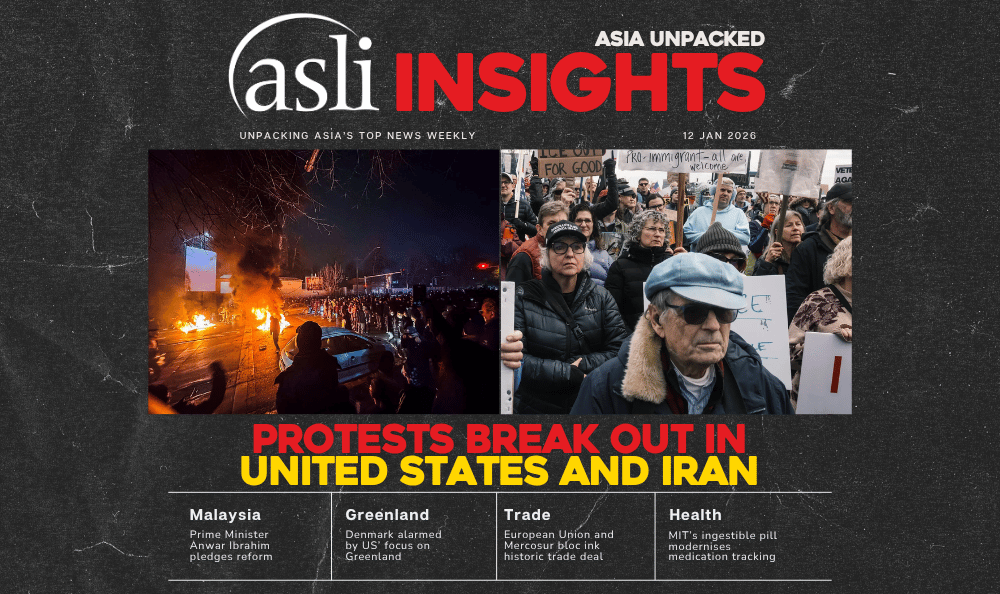
Protest movements are shaking Iran and the U.S., driven by allegations of state violence. In Iran, at least 51 people have died during demonstrations against the government and rising costs. Authorities imposed an internet blackout, while President Trump threatened to "hit back" if killings continue. Simultaneously, thousands in the U.S. are marching after the ICE shooting of Renee Nicole Good. While the administration claims her vehicle was "weaponized," video evidence has fueled cover-up accusations. Both nations face immense pressure to balance order with accountability and justice.
Read more:
2. Prime Minister Anwar Ibrahim pledges reform
Prime Minister Anwar Ibrahim has reaffirmed his commitment to long-promised institutional reforms, framing 2026 as a pivotal year for governance. Key measures include tabling bills to limit the Prime Minister’s tenure to ten years and separate the powers of the Attorney General from the Public Prosecutor. He also announced an Ombudsman Bill and a Freedom of Information Act to enhance public accountability. While supporters view these steps as essential for "cleansing the country of rot," critics suggest the timing—following recent state poll losses—indicates a move to regain political momentum. Additionally, he also emphasized that recent civil service wage increases must be matched by improved efficiency and digitalization to address rising public expectations and cost-of-living pressures.
Read more:
https://theedgemalaysia.com/node/788090
3. Denmark alarmed by US’ focus on Greenland
President Trump and top aides have intensified claims that acquiring Greenland is vital for U.S. national security, citing its geostrategic location in the Arctic and vast rare-earth mineral deposits. Following the military operation in Venezuela, U.S. rhetoric has shifted from purchase offers to refusal to rule out force. Danish Prime Minister Mette Frederiksen has condemned these "threats," warning that any aggression would jeopardize NATO. While Greenlandic leaders are open to U.S. investment, polls show 85% of residents oppose U.S. absorption. Denmark and European allies maintain that only Greenland and Denmark can decide the territory's future, dismissing the U.S. "Monroe Doctrine" framing as inapplicable to a fellow NATO founding member.
Read more:
https://www.nytimes.com/2026/01/05/world/europe/trump-greenland-why.html
4. European Union and Mercosur bloc ink historic trade deal
A majority of European Union nations approved the landmark Mercosur trade deal on January 9, 2026, creating one of the world's largest free-trade zones. Supporters, including Germany and Spain, view the pact as a strategic move to boost exports by €4 billion annually and reduce dependency on China. Conversely, France and Poland led opposition, fearing cheaper South American imports will devastate European farming. While the EU introduced a €6.3 billion crisis fund and stricter safeguards to win over skeptics like Italy, farmers across the continent continue to protest. The agreement now awaits final approval from the European Parliament.
Read more:
5. MIT’s ingestible pill modernises medication tracking
MIT engineers have developed a "smart pill" designed to notify healthcare providers once a patient swallows it, addressing the global challenge of medication non-adherence. The system uses a biodegradable zinc-cellulose antenna that activates within ten minutes of ingestion, sending a safe radio frequency signal to an external receiver. While most components dissolve in the stomach, a tiny, non-degradable sensor chip safely exits the body naturally. This technology aims to protect high-risk patients, such as organ transplant recipients and those with chronic infections, by providing reliable confirmation of dosage without changing the medication itself.
Read more:
https://news.mit.edu/2026/pills-communicate-from-stomach-could-improve-medication-adherence-0108
https://interestingengineering.com/health/mit-pills-communicate-from-stomach