ASLI INSIGHTS: Asia Unpacked | 4 Jul 2025
From political shifts to strategic deals, this week’s developments spotlight ASEAN’s growing role in trade, diplomacy, and green partnerships across Asia and Europe.
Top news in Asia this week:
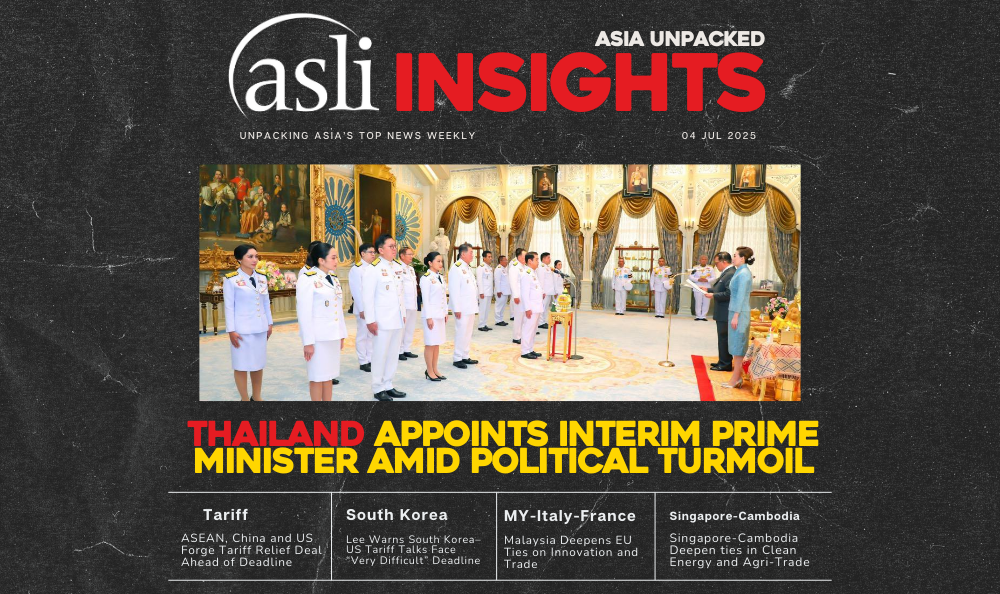
1. Thailand Appoints Interim Prime Minister Amid Political Turmoil
Thailand has appointed Phumtham Wechayachai as acting prime minister following the suspension of Paetongtarn Shinawatra by the Constitutional Court over an ethics investigation related to a leaked phone conversation with Cambodia’s former leader Hun Sen. Phumtham, previously deputy prime minister and interior minister, assumed the role on 3 July 2025, after Suriya Jungrungreangkit’s brief one-day tenure. Paetongtarn, despite her suspension, was sworn in as culture minister during the same cabinet reshuffle. The political instability has raised concerns about governance continuity and public trust in the administration.
Read more
2. ASEAN, China and US Forge Tariff Relief Deal Ahead of Deadline
As the U.S. deadline for tariff hikes approached, ASEAN nations, including Vietnam, pledged to increase imports from the United States to mitigate trade penalties. Vietnam and the U.S. reached a new agreement, capping tariffs at 20% for Vietnamese goods and 40% for transshipped items, avoiding the previously proposed 46%. President Trump announced the deal as part of broader efforts to narrow trade deficits. ASEAN leaders also expressed support for deeper economic engagement with the U.S. to preserve regional stability. Meanwhile, China acknowledged a developing trade framework, as Washington strengthens bilateral trade links across Asia. Although the deal helps avert immediate disruptions, critics argue it is a temporary fix lacking long-term solutions to structural imbalances in global trade relations.
Read more
3. Lee Warns South Korea–US Tariff Talks Face “Very Difficult” Deadline
South Korean President Lee Jae-myung warned that concluding a tariff deal with the United States before the approaching deadline would be “very difficult,” citing limited progress amid rising U.S. protectionism. The talks focus on shielding key South Korean exports from steep duties while maintaining economic ties with Washington. Lee also reaffirmed his commitment to rebuilding inter-Korean relations, pledging that cooperation with the U.S. would remain central to peace efforts on the peninsula. His administration faces mounting pressure to stabilise the economy and preserve global trade competitiveness. Despite diplomatic outreach, officials anticipate a complex path forward. Lee’s dual strategy highlights his attempt to balance economic resilience with regional diplomacy in a politically sensitive and increasingly protectionist global environment.
Read more
4. Malaysia Deepens EU Ties on Innovation and Trade
Malaysian Prime Minister Anwar Ibrahim embarked on official visits to Italy and France aimed at strengthening strategic ties in trade, energy, and innovation. In Rome, he met Italian Prime Minister Giorgia Meloni and witnessed business discussions involving potential investments worth RM8.13 billion and potential exports totalling RM425 million. Anwar also invited Italian firms, including Leonardo and ENI, to participate in Malaysia’s energy transition and high-tech sectors under NETR and NIMP 2030. In Paris, the Prime Minister is scheduled to meet with President Emmanuel Macron, with discussions set to cover key agenda items such as trade, investment, renewable energy, semiconductors, defence, education, digital economy, and artificial intelligence (AI). The visits reflect Malaysia’s ambition to position itself as a regional investment hub while enhancing partnerships with key EU economies in support of sustainable growth, technological advancement, and geopolitical collaboration.
Read more
5. Singapore-Cambodia Deepen ties in Clean Energy and Agri‑Trade
Singapore and Cambodia have agreed to expand bilateral cooperation in renewable energy, carbon markets, and agricultural trade. The partnership will support joint initiatives in solar energy, emissions reduction, and food sustainability. Singapore aims to share technical expertise and financing models, while Cambodia seeks to modernise its agri-export industry and improve access to clean technology. Both nations also discussed regional carbon credit frameworks and green capacity-building programmes. The agreement reflects a shared commitment to climate action, sustainable development, and resilient food systems. It also supports ASEAN’s broader goals of economic integration and environmental sustainability. The collaboration underscores Singapore’s role as a regional green finance hub and Cambodia’s ambition to diversify its economy through sustainable and innovation-driven partnerships.
Read more
Empowering Leaders, Advancing Societies