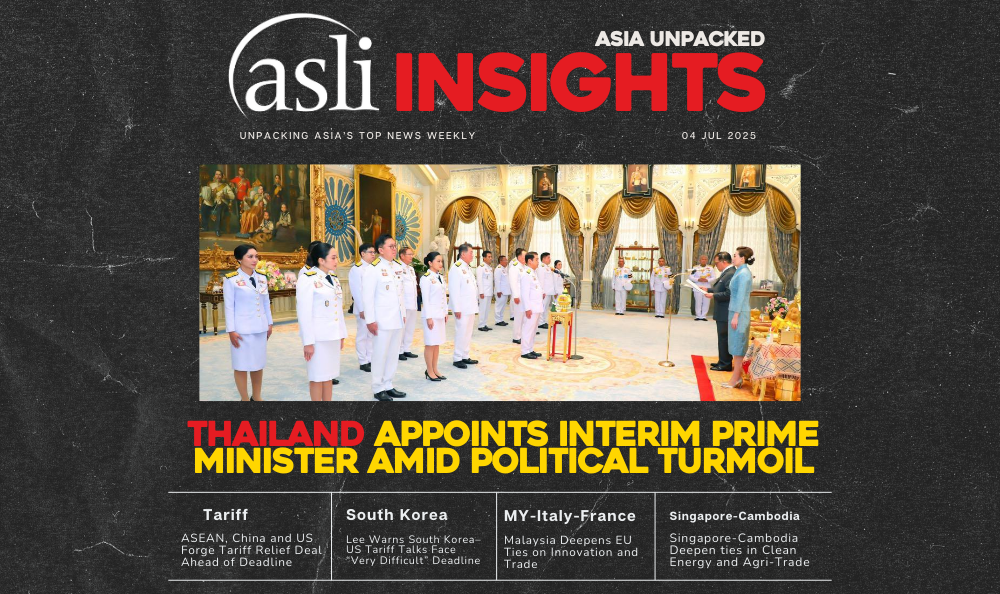
ASLI INSIGHTS: Asia Unpacked | 12 Jul 2025
From bold appointments to quiet diplomacy, this week Asia balances spectacle with strategy — from Trump’s eyebrow-raising ambassador pick for Malaysia to ASEAN’s measured response on tariffs and neutrality.
Top news in Asia this week:
1. Trump Appoints ‘Alpha Male’ as Ambassador to Malaysia
Donald Trump has nominated Nick Adams, an Australian‑born conservative influencer and self‑described “alpha male,” to serve as the next U.S. ambassador to Malaysia, pending Senate confirmation. Though he served briefly in local Australian politics and became a U.S. citizen in 2021, Adams lacks formal diplomatic experience. Known for brash online persona, rare steaks, and provocative culture-war rhetoric, his nomination has drawn widespread criticism from diplomats concerned it prioritizes loyalty over professional experience. Analysts warn his bold persona may clash with Malaysia’s preference for subtle diplomacy.
Read more:
2. India’s Treaty Freeze used as Water Leverage in Kashmir Dispute
In response to a militant attack in Indian-administered Kashmir, India suspended the 1960 Indus Waters Treaty, citing national security, terrorism allegations, and shifting needs in water and energy. Though scholars emphasize India lacks infrastructure to significantly block western-river flows, Pakistan warns any disruption could devastate its irrigated agriculture and hydropower sectors. The freeze also halts treaty-mandated data sharing. Rising climate pressures—melting glaciers, monsoon shifts—intensify water vulnerabilities . Pakistani leaders have described the move as an “act of war” and are appealing to international bodies like the World Bank, while India stresses the treaty’s inequities and seeks modernization.
Read more:
3. Bridges Not Barriers: Asia’s Calm Response to Trump Tariffs
In response to President Trump’s expansive tariffs of 25–40% on several Southeast Asian nations have uniformly declined retaliation and instead seek diplomacy and trade diversification. Nations including Malaysia, Indonesia and Thailand are engaging Washington individually and as a bloc, aiming to negotiate tariff reductions before the August 1st implementation. Concerned about economic disruption, ASEAN is accelerating regional integration via RCEP, intra-ASEAN trade, DEFA, and digital economic frameworks. The bloc also emphasizes maintaining neutrality amid broader U.S.–China rivalry. U.S. Secretary of State Rubio’s visit underlines Washington’s intent to reassure regional partners.
Read more:
https://www.bernama.com/en/general/news.php?id=2443375x
4. ASEAN Foreign Ministers Meet with Focus on Neutrality and Resilience
From July 8–11 in Kuala Lumpur, Malaysia hosted the 58th ASEAN Foreign Ministers’ Meeting, chaired by Prime Minister Anwar Ibrahim, who stressed stronger alignment between ASEAN's foreign and economic policies to weather shifting geopolitics and trade tariffs, labeling them the “new weather of our time”. He urged regional unity, strategic autonomy, and strengthened intra-ASEAN trade. U.S. Secretary of State Marco Rubio, making his first Asia trip, met counterparts amid concerns over looming U.S. tariffs on multiple Southeast Asian economies ASEAN leaders emphasised neutrality, resilience, and multipolar engagements—including dialogues with the U.S., China, and Russia—to safeguard regional stability and cohesion.
Read more:
https://www.channelnewsasia.com/commentary/trump-tariffs-japan-taco-trade-deal-damage-5226636
5. BRICS Alliance Seeks Fairer World Order at Rio
At the 2025 BRICS Summit in Rio de Janeiro, leaders from an expanded bloc emphasised the need for inclusive global governance, calling for UN reform and sustainable development frameworks. The group opposed rising protectionism, though avoided directly naming the U.S. This comes as President Trump threatens tariffs on several BRICS and ASEAN nations. Malaysia, while seeking negotiation, has declared it will not compromise on core sovereign policies, including halal regulation and digital policy. The BRICS summit also endorsed climate finance and equitable AI governance. The bloc’s expansion reflects a shift toward multipolarity and greater influence from emerging economies.
Read more:
https://apnews.com/article/brics-summit-brazil-2025-lula-ee830be326e295fed787032abf43d59a
https://www.reuters.com/world/china/leaders-growing-brics-group-gather-rio-summit-2025-07-06/